Showing posts with label Crafts. Show all posts

Sunday, December 22, 2013

[Movie] A lighting test at Samukawa Temple, for a nebuta float that welcomes the New Year with a legend/Kanagawa

Translated from the original article at: http://news.kanaloco.jp/localnews/article/1312200043/

December 20, 2013
The nebuta float of Samukawa Temple, set up for a lighting test.

At Samukawa Temple (Miyayamai, Samukawa-Cho, Chief Priest: Tone Yasunori) the annual welcoming of the New Year with a float featuring a legend, was set up on the 20th at the shrine's gates. It's been set to light up on 12:00 AM, New Years Day.

[Movies]

This year's theme is Ama No Iwato (Cave of the Sun God). Aomori prefecture's nebuta artist, Kitamura Renmei, spent three months on it's creation. During the process, he poured in his wishes for people to seek and embrace hope for Japanese economic revival during the dawning of each day, as well as to take one steady step at a time towards a happy 2014.

The nebuta is 9 meters wide, 2.6 meters tall and 1.7 meters deep. The float's 250 light bulbs giving off an eerie glow, the lighting tests are performed in the evenings. The float will remain lit at night until February 3rd of next year, welcoming visitors to the shrine.


Original text:
【動画】神話ねぶたで正月出迎え、寒川神社で試験点灯/神奈川
2013年12月20日

試験点灯された寒川神社のねぶた

寒川神社(寒川町宮山、利根康教宮司)で恒例の迎春神話ねぶたが20日、神門に設置され、元日午前0時の点灯へ準備が整った。

【動画】

今年のテーマは「天の岩屋戸(いわと)」。青森ねぶた師の北村蓮明さんが約3カ月かけて制作。経済回復の兆しが見える日本の夜明けに希望を抱き、着実な一歩を踏み出し幸せな一年になるよう、願いが込められている。

ねぶたは幅9メートル、高さ約2.6メートル、奥行き1.7メートル。試験点灯した夕暮れ時には、約250個の電球が幻想的な光を放った。来年2月3日まで夜間に点灯され、参拝客らを出迎える。

Tuesday, December 4, 2012

Preparing for spring quite early, the New Years' kadomatsu stand at Ishiwara Temple's torii gate.

Translated from the original article at: http://headlines.yahoo.co.jp/hl?a=20121201-00000302-rtn-l26

Distributed by the Sankei Shinbum (http://sankei.jp/) on Saturday, December 1, 2012, 6:36 PM

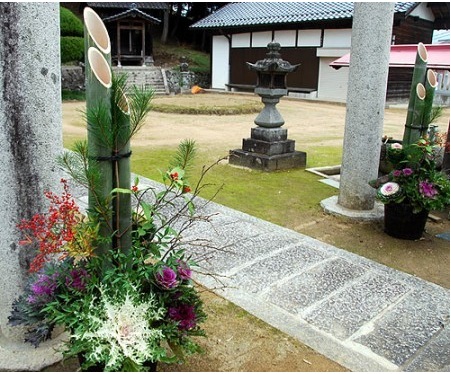
Kadomatsu alongside the torii gate.

Spring preparations have come even earlier. At the Ippin Temple of Ishiwara, Fukuchiyama City, a set of kadomatsu stand across from each other. Created by a local man of 70 years, people strolling by are reacting with surprise. "There's already some kadomatsu. It's sure early..."

The kadomatsu are each 1.5 meters high. Besides being made with bamboo, plum wood and pine, nandina  and atukan are added as decorations. Additionally, kale sprouted from seeds of this year's summer decorate the gates.

Before, the local man worked a job where he decorated kadomatsu by hand. "Because of how hot it got during the summer, I was worried about the growth of the cabbage, but it turned out quite beautiful. This is a most excellent kadomatsu," he said, appearing full of satisfaction.


Original text:
早くも迎春準備 石原の神社に正月用門松立つ
両丹日日新聞 12月1日(土)18時36分配信

鳥居のそばに立つ門松

早くも迎春準備-。福知山市石原、一品神社に門松1対が立てられた。地元の男性(70)が作ったもので、散歩の人たちも「もう門松。早いなあ」と驚いている。

門松の高さはそれぞれ約1・5メートル。竹や梅、松のほか、ナンテン、センリョウを配している。今夏に種をまいて育てたハボタンもあしらった。
  
男性は以前に勤めていた職場に、手作りの門松を飾ってきた。「ハボタンが夏の暑さで育つか心配だったが、きれいになり、門松も上々の出来」と満足そうに話していた。

Sunday, December 2, 2012

At the Tsurugaoka-Hachimangū shrine, a scene of the finishing touches being applied to evil-warding arrows/Kamakura

Translated from the original article at: http://news.kanaloco.jp/localnews/article/1212010027/

December 1, 2012
A look at the completion of evil-warding arrows=Tsurugaoka-Hachimangū shrine

At the Tsurugaoka-Hachimangū shrine (Yuki No Shita, Kamakura City), the time has come to apply the finishing touches to many hamaya (evil warding arrows). As the New Year approaches, 24,500 arrows of various sizes are being prepared.

After Minamoto No Yoriyoshi ended the Zenkunen War that took place during the late Heian period, (Tsurugaoka’s) bow and arrows have been offered to Hachiman, the God Of War enshrined at Yuiga Beach.

At the tip, the head of the arrow is wrapped with Japanese style paper, then decorated with a bell. As the miko (shrine maidens) skillfully hammer on the arrowheads, echoes can be heard throughout the shrine during the year’s final month.


Original text:
鶴岡八幡宮で破魔矢仕上げ、佳境を迎える/鎌倉
2012121

佳境を迎えた破魔矢の仕上げ=鶴岡八幡宮

鶴岡八幡宮(鎌倉市雪ノ下)で、破魔矢の仕上げが佳境を迎えた。新年に向け、大小24万5千本を用意する。

源頼義が平安時代後期の前九年の役を平定後、由比ケ浜の八幡神に奉納した弓矢にちなむ。

矢の先端の鏑(かぶら)に和紙を巻き、鈴で飾る。巫女(みこ)が手際よく鏑を打ち付け、師走の境内に「コンコン」と響く。

Sunday, November 11, 2012

Crowds seek lucky talismans at the Kotohira Ōtori Jinja Shrine “Tori no Ichi” Festival/Yokohama

Translated from the original article at: http://news.kanaloco.jp/localnews/article/1211080036/

November 8, 2012
People looking to purchase lucky talismans=Kotohira Ōtori Jinja Shrine, Minimi-ku, Yokohama

For those praying for prosperity in their business, the annual Tori No Shi Festival was held on the 8th at the Kotohira Ōtori Jinja Shrine, located in Yokohama's Southern District. The event was crowded with people seeking good luck charms.

Located alongside a park, the main street featured lines of stores selling glittering kumade, decorated with bails of rice and koban coins. Whenever a kumade was sold, the powerful echoes of shopkeepers calling out "Great profits, huge  prosperity!" could be heard.

Ōkawa Tsutomu (39), manager of a yakiniku restaurant in Asahi-ku, Yokohama said "Every year, I come to purchase a new kumade, which seems to be getting larger each year. I pray my business grows in size as well."


Original text:
金刀比羅大鷲神社で酉の市、縁起物求めにぎわう横浜
2012118

縁起物を買い求める人たち横浜市南区の金刀比羅大鷲神社

商売繁盛を祈願して、横浜市南区の金刀(こと)比羅(ひら)大鷲(おおとり)神社で8日、毎年恒例の「酉(とり)の市」が開かれ、縁起物を買い求める人たちでにぎわった。

大通り公園沿いには、米俵や小判できらびやかに飾り付けられた縁起物の熊手を扱う露店がずらり。熊手が売れるたびに、「商売繁盛、大繁盛」などと威勢のいい掛け声が響き渡った。

焼き肉店を経営する横浜市旭区の大川努さん(39)は「毎年新しい熊手を買いに来ているが、だんだんと大きいものを購入するようにしている。さらなる商売繁盛を願いたい」と話していた。

Thursday, October 25, 2012

[Video news] At Hiratsuka, the production of snake (Chinese zodiac) daruma dolls reach their peak.

Translated from the original article at: http://news.kanaloco.jp/localnews/article/1210240018/

October 24, 2012
The peak period for creating snake (Chinese zodiac) darumas.

2013 will the year of the snake. Founded 150 years ago, the long established Arai Daruma (Higashiyawata, Hiratsuka) store enters peak production of snake (Chinese zodiac) darumas.

With the money in 2004, the store began creating Chinese zodiac darumas. This year marks their 10th type of animal.

"The snake is associated with Bentensama (Benzaiten). In order to increase one's luck with money, the darama has been inlaid with gold and platinum lamé. The color is gorgeous," said Arai Seikan (57), 4th generation owner of Arai Daruma.

The darumas will be unveiled on November 4th at the Hiratsuka business festival. They will be sold at places such as the Yokohama and Yokosuka Tori No Shi festivals and the Iizumi Kannon Daruma City.


Original text:
【動画ニュース】平塚で巳(へび)の干支だるま製作ピーク
2012年10月24日

製作がピークを迎えた巳(へび)の干支だるま

2013年の干支、巳(へび)の干支だるまの制作が、創業150余年のだるま制作の老舗「荒井だるま屋」(平塚市東八幡)でピークを迎えた。

2004年の申(さる)から作り始め、今年で10体目となる。

「へびは弁天様の使い。金運が上がるよう、金色とプラチナ色のラメをちりばめ、ゴージャスにしました」と4代目店主の荒井星冠さん(57)。

初お披露目は11月4日の平塚商業まつり。横浜と横須賀で開かれる酉の市、飯泉観音のだるま市などで販売される。

Tuesday, October 16, 2012

[Video news] The Efudutsuku Festival and Brush Memorial Service is held at the Egara Tenjin Shrine. Manga artists display this andon (lamp) creations and more/Kamakura

Translated from the original article at: http://news.kanaloco.jp/localnews/article/1210140035/

October 14, 2012
The Efudutsuku Festival takes place at the Egara Tenjin Shrine, where old brushes are burned in a ritual=Nikaido, Kamakura City

On the 14th, the Egara Tenjin Shrine of Nidaido, Kamakura City held the Efudutsuku Festival, where 500 used writing brushes were offered in a ceremony. Manga artists involved with the temple also attended.

The manga artists had their andon lamps on display. With the festival focusing on Sugawara No Michizana, "The God of Scholarship" the term "合格" (Gokaku, "To pass an examination") connected 94 assembled works of the artists.

The event began with the favorite painting brushes of the late, well known manga artist Kon Shimuzu being offered in ceremony. In remembrance of Shimizu, who was famous for his depictions of the kappa a collection of his kappa manga was used in the ceremony.


Original text:
【動画ニュース】荏柄天神社「絵筆塚祭」で古筆供養、漫画絵あんどんもお披露目/鎌倉
20121014

荏柄天神社の「絵筆塚祭」で供養される古筆=鎌倉市二階堂

漫画家ゆかりの鎌倉市二階堂の荏柄天神社で14日、「絵筆塚祭」が行われ、古筆約500本が供養された。

漫画絵あんどんもお披露目された。学問の神様・菅原道真を祭ることから、「合格」にちなんだ94作が集まった。

この催事は、かっぱ漫画で知られる故・清水崑さんが愛用した絵筆をこの神社に供養したことから始まった。清水さんをしのび、かっぱの漫画絵も寄せられた。

Wednesday, October 10, 2012

"It's already time for Osechi?" Models of Osechi ingredients enter the final stage of production/Yokohama

Translated from the original article at: http://news.kanaloco.jp/localnews/article/1210100013/

October 10, 2012
Display models of Osechi in the final stage of production.

Is it already time for Osechi? Not quite, these are just display models. At food replica manufacturer Iwasaki Bei's Yokohama factory (Tsurumichuo, Tsurumi Ward, Yokohama City), the production of mock-ingredients for New Year's Osechi enters the final stage of production.

The various models are formed out of silicon. After being filled with a plastic resin, they're put inside of a heating oven to harden. The models are then colored with items used for oil painting. While looking at (actual) pictures of the foods, a painting brush is used to add and accentuate the colors.

"These products of the number one way to attract customers to restaurants. They do the job at getting people to spontaneously want to eat at the restaurant," explained a company representative.


Original text:
もう、おせち? おせち料理のサンプル作りが追い込み/横浜
2012年10月10日

もう、おせち? いえ、サンプルです-。食品サンプル製造「イワサキ・ビーアイ」の横浜工場(横浜市鶴見区鶴見中央)で、正月用おせち料理のサンプル作りが追い込みを迎えている。

追い込みを迎えている、おせち料理のサンプル作り

シリコーンでできたさまざまな食品の「型」を用意し、その中にビニール樹脂を流し込んでオーブンで加熱して固める。着色には油絵の具を使用。写真を見ながら、絵筆を使って色を重ねていく。

「お客さんに繁盛してもらうのが一番。思わず食べたくなるように仕上げています」と担当者は話していた。

Wednesday, July 18, 2012

Breathing life into a fusuma painting, the panels are completed at Kenchō-ji Temple/Kamakura

Translated from the original article at: http://news.kanaloco.jp/localnews/article/1207130031/

July 14, 2012
The completed "dragon king" fusuma painting=Kenchō-ji Temple, Yamanouchi, Kamakura City

At Kenchō-ji Temple of Yamanouchi, Kamakura City, a "king dragon" fusuma painting has been completed. It was produced by the ink-wash painting artist Mr. Hakurō (age 67), who was born in China.

With the sun and moon being placed across the right and left of the scene, the painting represents "the ruler of heaven and earth". On the 14th, the panel decorated the temple's own dragon king hall.

The drawings were done on 4 sheets of “echizen washi” paper, each roughly 2 square meters in size. 20 different fur brushes of various sizes were used. Light touches were used for dots, vigorous strokes for lines, and sliding spin strokes for the parts of the surface covered in ink. "I attached…breathed my life into it," said Mr. Hakurō.

Lining up both sides (of the room they're placed in), the temple grounds have 16 fusuma panels, also displaying juniper, Mount Fuji and the Shounan Sea. The dragon fusuma was newly created to coincide with 2012's Year of the Dragon. One year was spent on the design. Two weeks were necessary for production.


Original Text:
ふすま絵に吹き込む命、建長寺で完成/鎌倉 
2012714

完成した竜王のふすま絵鎌倉市山ノ内の建長寺

鎌倉市山ノ内の建長寺で、中国出身の水墨画家・白浪(はくろう)さん(67)が竜王のふすま絵を完成させた。

左右に太陽と月を配し、「天地の支配者」を表した。龍王殿に14日、飾られる。

およそ2メートル四方の越前和紙のふすま4枚に描いた。大小20の毛筆を操り、かすらせて「点」、立てて「線」、滑らせて「面」を紡いだ。白浪さんは「命を懸けて命を吹き込んだ」。

両脇に連ねるふすま16枚に境内のビャクシン、富士山、湘南の海をあしらった。辰(たつ)年に合わせて新調。構想1年、制作2週間を要した。

Friday, June 29, 2012

At the peak of their production, paper lanterns are carefully created before summer festival season/Odawara

Translated from the original article at: http://news.kanaloco.jp/localnews/article/1206290013/

June 29, 2012
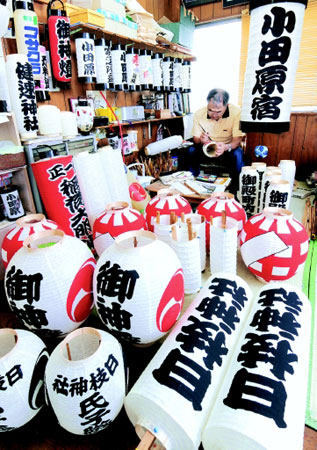
Patterns and letters being crafted by hand=Yamazaki Lantern Store(Iidaoka, Odawara City)

Right before the summer festivals, Yamazaki Lanterns of Iidaoka, Odawara City reaches it's busiest production period.

A 4th generation lantern maker, Yuu Yamazaki (71) primarily receives orders from within the Kanagawa prefecture, with others coming in from Saitama and Yamagata. Hand-making the lanterns one by one, he carefully adds the patterns and letters. Right now, he's producing many "stretched moon" lanterns as well as regular lanterns both to be used for decorating mikoshi. In one day, he completes upwards of 10 lanterns.

Because of last year's earthquake disasters, his store saw a decrease in orders by 2/3rds, as one festival after another restrained themselves. This year, it's said that orders have returned to normal.


Original text
提灯づくりがピーク、夏祭りシーズン前に手作業で丁寧に/小田原
2012年6月29日

手作業で模様や字入れを行う=山崎提灯店(小田原市飯田岡)

夏祭りシーズンを前に提灯(ちょうちん)づくりが小田原市飯田岡の「山崎提灯店」でピークを迎えている。

4代目の山崎勇さん(71)は県内をはじめ、埼玉や山形からも注文を受け、一つ一つ手作業で丁寧に模様や字入れを行っている。この時期はみこしを飾る弓張(ゆみはり)提灯やほおずき提灯の製作が多く、1日に10張り程度を完成させていく。

昨年は震災の影響で祭りの自粛が相次ぎ、注文が3分の2ほどに減ったが、今年は例年並みに戻ったという。

Wednesday, June 13, 2012

With their sounds protecting the town, wind bell production enters it's final stage/Kanagawa

Translated from the original article at: http://news.kanaloco.jp/localnews/article/1206120036/

June 13, 2012
Approaching the completion of wind bell production at Kamakura Bells=Yuigahama, Kamakura City

The Kamakura Bells store of Yuigahama, Kamakura City approaches its completion of wind bell production. The copper is beaten in order to alter the sounds which are produced. The application of smoldering bamboo forms the designs.

Wind bell specialist Makoto Kikuchi's (58) past work included teaching at elementary, junior high and special education schools. As a working adult, he entered into Kyuutakaoka Junior College of Toyama Prefecture, studying the local industry of casting as a metal arts specialist. Establishing a studio within Kamakura City, he opened a store selling his wind bells 8 years ago.

In the store, display models of the wind-bells are set out, their sound frequency recorded on an attached card. Kikuchi explained: "During Japan's Middle Ages, it was thought that the sound of the bells could bring protection to entire towns. While analyzing the scientific aspect of the sound, I wish to create bells capturing the essence of the seasons of the year and nature within Kamakura."


Original text:
風鈴作り追い込み、町守る音を/神奈川
2012613

風鈴作りが追い込みを迎えている「鎌倉ベルズ」鎌倉市由比ガ浜

鎌倉市由比ガ浜の「鎌倉ベルズ」で風鈴作りが追い込みを迎えている。銅をたたく加減で音色に変化を与え、竹で燻(いぶ)して模様を施す。

風鈴作家の菊地眞さん(58)は小、中学校、特別支援学校の教諭を歴任した後、旧高岡短大(富山県)に社会人入学し、金属工芸専攻で地場産業の鋳物を学んだ。鎌倉市内に工房を構え、8年前からは店舗で風鈴を売り出した。

店に展示している見本の風鈴には、奏でる音の周波数を記した札が付く。菊地さんは「中世には音によって町全体を守る概念があった。音を科学的に分析しながら、鎌倉の四季や自然を想起させる風鈴を作っていきたい」と話していた。

Wednesday, April 25, 2012

A town's revitalization effort rides the winds. 150 Nobori are placed over Tama's Gotanda River/Kawasaki


Translated from the original article at: http://news.kanaloco.jp/localnews/article/1204240035/

April 25, 2012
Koi (fish) nobori decorate the Gotanda River=Tama Ward

Over the Gotanda River of Ikutawa, Tama Ward, Kawasaki City, Koi Nobori pleasantly swim in the light winds.

Aiming to revitalize their town, a self-governing committee of Gotanda residents have been using a house to collect koi nobori not in use. Since posting a notice 4 years prior, the number of flags have increased each year, totaling 150 in 2012. The sight of them can be enjoyed until May 5th.

Continuing the desire for revitalization from last year's earthquake disaster, messages such as "Help the North-East" were written on the abdomens of 6 koi nobori. A member of the committee visited Minamisanriku Town, Miyagi Prefecture in February. Having taken pictures of the location, they're now being displayed along the side of the river.

Chizuko Nakamura (65), a housewife of Tama: "We're glad to see so many koi nobori nearby. We hope our grandchildren can come visit and see them during Golden Week," she said with a smile.


Original text:
町おこし願い風に乗せ、多摩の五反田川上にこいのぼり150匹/川崎
2012年4月25日

五反田川上に飾られたこいのぼり=多摩区

川崎市多摩区生田の五反田川の上で、こいのぼりが薫風に乗って気持ち良さそうに泳いでいる。

町おこしを狙い、地元の五反田自治会が家で使わなくなったこいのぼりなどを集めて、4年前から掲出。年々数を増やし、今年は150匹を並べた。5月5日まで楽しめる。

昨年に続き、震災復興を願って「東北応援」などとメッセージが腹に描かれたものも6匹登場。同自治会役員が2月に宮城県南三陸町を訪れた際に、現地を撮影した写真も川沿いに展示している。

区内に住む主婦中村千鶴子さん(65)は「身近でこんなにたくさんこいのぼりを見られるのはうれしい。ゴールデンウイーク中に孫を連れてきたい」と笑顔で話していた。

Wednesday, March 28, 2012

Going out for the Duanwa Festival, Tairyou-bata flags enter the peak of production/Miura

Translated from the original article at: http://news.kanaloco.jp/localnews/article/1203260011/

March 26, 2012

The arrival of the peak production period for Tairyou-bata =The Mitomi Dyed Goods Store of Misaki, Sanpo City

In anticipation of the Duanwu Festival, celebrating the health of boys, the production of Tairyou-bata is at it's peak at Mitomi Dyed Goods of Misaki, Sanpo City. With this being the year of the dragon, many people have requested it's design on the flags.

Working by hand, Mitomo Yoshitaka (Age 32) is a 7th generations flag producer, carrying on the family tradition beginning in 1833 during the Edo period. Tairyou-bata are given to the owners of newly constructed ships as presents to be displayed, used to pray for safe voyages and bountiful fishing. Lately, they've also been used to celebrate children's birthdays, store openings and as various good luck charms.

Helping out the damaged area after the Eastern Japan Disaster, Mitomo has been exchanging gifts with the Sanriku area, offering dyed Tairyou-bata to owners of newly constructed fishing boats, written with messages for the area's recovery.

"However possible, we're celebrating the turning points of life and starting anew." said Mr. Mitomi.


Original text:
門出に大漁旗を、端午の節句へ製作ピーク/三浦
2012年3月26日

ピークを迎えた大漁旗の製作=三浦市三崎、三富染物店

浦市三崎の三富染物店で、端午の節句を控え、男の子の誕生を祝う大漁旗の製作がピークを迎えている。ことしの干支、龍のデザインを依頼する人も多い。

手掛けるのは、江戸時代の1833年から続く7代目、三冨由貴さん(32)。大漁旗は航海安全と大漁を祈り、新造船がお披露目されるたびに船主へ贈られてきた。最近では子どもの誕生や開店祝いなど、さまざまな祝い事の縁起物としても使われている。

東日本大震災以降は被災地を元気づけるための寄せ書き用や修復、新築した三陸地方の漁船へ贈答する大漁旗も染め上げた。

三冨さんは「人生の門出や節目を祝うことができれば」と話している。

Saturday, February 25, 2012

The blue eyed doll of Maebashi Joutou Elementary School returns home, to be displayed at a museum in America

Translated from the original article at: http://takasaki.keizai.biz/headline/1644/

February 24, 2012
Virginia, a gift from the immigrant missionary Sidney Gulick in 1927.

In possession of the Maebashi Joutou Municipal Elementary School (Maebashi Joutou1) is the blue eyed doll, Virginia. From March 2nd, the Taubman Museum of Roanoke City, Virginia will have it on display.

Virginia one of the dolls American Missionary Sidney Gullick sent to Japanese schools in 1927, aiming for goodwill between the countries. Of the 142 dolls originally sent to schools of Gunma prefecture, less than 20 remain.

Maebashi Joutou Elementary School owns 2 other dolls besides Virginia. The blue eyed "Nina" was park of Tokyo’s blue eyed doll display in 1978. From there, Virginia’s doll-friends were to be transferred among girls in America.

At an exchange conference in 1995, the other doll “Ema” was donated to America in an effort to strengthen the countries’ goodwill towards each other.

Virginia has now returned to America twice. The first time was in 1979. A child of the school's PTA interested in visiting America left the doll to strengthen relations. On February 17th, receiving orders from Roanoke's mayor, Mr. and Mrs. Janboor (Roanoke city residents) received the doll after having had a discussion with the school. It’s not to say that this is a reflection of Japanese relations with America.

Until the end of June, Virginia, Norman (Japanese site) and Grace (Japanese site) will be displayed at the Taubman Museum.


Original text:
前橋城東小の「青い目の人形」が里帰り-米国の美術館で展示へ
20120224

1927(昭和2)年に米国人宣教師のギューリック1世から贈られた「バージニア」

前橋市立城東小学校(前橋市城東1)所有の「青い目の人形」、バージニアが32日から、米国バージニア州のターブマン美術館(ロアノーク市)に展示される。

バージニアは1927(昭和2)年、米国人宣教師のギューリック1世が日米親善を目的に日本の学校に配布したうちの1体。当時、群馬県内の学校だけでも142体の寄贈を受けたが、現存するのは20体に満たない。

同校にはバージニアの他に2体の人形がある。そのうちの1体はニーナで、1978(昭和53)年に東京で開催された「青い目の人形展」がきっかけで、バージニアの「お友達に」と米国人の少女から譲り受けたもの。

もう1体のエマは人形による日米親善に尽力する交流会を通じ1995年に寄贈された。

バージニアの里帰りは2回目で、1979(昭和54)年の里帰りの際には同校PTA・児童の有志が米国を訪れ、親交を深めた。今回は世情を反映してか渡米はしなかったが、217日、ロアノーク市長の命を受けジャンボール夫妻(ロアノーク市在住)が同校を訪問し、預かった。

ターブマン美術館にはバージニア、ノルマン(愛知県)、グレイス(同)の3体が展示される。6月上旬まで。

Monday, February 13, 2012

Producing high quality paper during the coldest of times; cold paper creation at the Tanaka Paper Manufacturing Center of Ōe.

Translated from the original article at: http://www.ryoutan.co.jp/news/2012/02/12/004768.html

February 12, 2012
Mr. Tanaka rhythmically inserts and moves the paper.

The production of Tango style Japanese paper (Washi) continues in Futamata, Ōe Town (Fukuchiyama city). At the Tanaka Paper Manufacturing Center, this season is welcomed as the peak period for the creation of paper. During this period of severe cold, washi of exceptionally high quality is carefully produced (through cold paper processing), one sheet at a time.

The Tanaka Paper Manufacturing Center has been in business since the Edo period, using the town's own paper mulberry. While the paper is created year round, the months of January and February are when raw material production and cold paper processing overlap, making it the busiest work period. 

Toshihiro (Age 50) is the 5th generation from the Tanaka family to deal with cold water paper manufacturing at Tanaka Paper Manufacturing Center. Stretching the paper in a vat of water, the fiber of the leaf mulberry dissolves. The Aibika plant is placed into the water, creating a paste. The mulberry is then inserted and mounted on a sudare, creating the paper.
 
Skillfully controlling the equipment, a "Zabu zabu zabu" of splashing water can be heard inside the container. 200 to 300 papers are piled in a bed atop each other. Afterwards, a jack is used to press out the excess liquid, and the papers are individually left out to dry in the sun. 

The cold water production will continue until the end of March. Mr. Tanaka said "Production during the frigidness of this year's winter was easy. Although my hands are freezing, I have the piece of mind that I created some excellent paper." Cold water processing is used to create paper for such things as a certain type of Fusuma and picture scrolls. It's said to often be used for restoring pre-existing cultural artifacts.


Original text
厳寒期こそ良質の和紙 大江の田中製紙工業所で寒漉き
2012年2月12日

写真=リズミカルにすげたを動かす田中さん

福知山市内で手漉き和紙(丹後和紙)作りを続ける大江町二俣、田中製紙工業所で、この季節ならではの「寒漉き」が最盛期を迎えている。厳寒期に漉く和紙は特に良質で、一枚一枚丁寧に仕上げられている。

江戸時代から続く田中製紙工業所では、町内産のコウゾを使い、年中和紙を作っているが、1、2月は和紙の原料作りと寒漉きが重なり、最も忙しい時期となる。

寒漉きは工業所5代目の田中敏弘さん(50)が手掛ける。水を張った漉きぶね(水槽)の中に、コウゾの繊維を溶かした液と植物のトロロアオイの粘液を入れ、すだれを乗せた道具・すげたを使って漉いていく。

すげたを巧みに操ると、「ざぶ、ざぶ、ざぶ」と漉きぶねの中が波打つ。漉き上がった紙は紙床の上に乗せ、200-300枚ほど重ねたあと、ジャッキで圧力をかけて水を切り、一枚ずつ天日干しする。

寒漉きは3月上旬まで続く。田中さんは「今年の冬は寒くて作業がしやすい。手は冷たいですが、良質の紙が作れるので安心です」と話す。寒漉きで作られた紙は障壁画や軸物などの文化財の修復に使われることが多いという。

Wednesday, January 25, 2012

Thanks to the feverish work of students under pottery expert Ifukube Rei, reproductions of Jōmon period earthenware are on display/Atsugi

Translated from the original article at: http://news.kanaloco.jp/localnews/article/1201240021/

January 25, 2012

The works on display bring out the romance of the Jōmon period  = The Citizen's Gallery of Nakacho, Atsugi City

The breath of life overflows from the Jōmon earthenware display, held at the Citizen's Gallery of Nakacho, Atsugi City (Located in the Aeon Shopping Mall (Japanese site). Admission is free. Open until 1:00PM of January 30.

The event was organized by the "Creation of Jōmon Earthenware" academic course, in which Ifukube Rei supervises fourteen students at a time. The course takes place twice a month. It’s taught by pottering expert Ifukube, who has been creating Jōmon earthenware for over 30 years. In April and August, the pieces are completed in a controlled burning, as was done in the Jōmon period.

At the event location is a lineup of 100 of the students pieces, primarily based on records of originally excavated remains. Because of the students’ devotion to their work, it's as if the pieces displayed have once again been excavated from the Earth. Such things as Dogū (Clay figures) and Jinmen (People Faces) (Japanese site) used for rituals, Doban (Clay panels) (Japanese site) and of course earthenware will be on display. This group of students can be called orthodox, as they even attached handmade knot patterns made of string to the front of the earthenware.

Ifukube Rei had an interest in archeology before, but is presently consulting the earthenware manufacturing methods in each area of South East Asia. In doing this, she's looking for an understanding on the beginnings of earthenware production during the Jōmon period. "The design of Jōmon earthenware is rich in appeal. Pottery experts still feel completely astounded from the pieces of 10,000 years before." Those visiting the gallery don't have to just appreciate the earthenware for its aesthetic value. The pieces are also planned to be used for boiling and cooking.

For questions, Ifukube can be reached at 046(247)4894.


Original text
忠実に再現・縄文土器、陶芸家の生徒が力作披露/厚木
2012年1月25日

縄文のロマンを感じる作品点=厚木市中町の市民ギャラリー

生命の息吹あふれる縄文土器の作品展が厚木市中町の市民ギャラリー(イオン厚木店)で開かれている。入場無料。30日午後1時まで。

「縄文土器創作講座」(伊福部(いふくべ)玲主宰、14人)の主催。同講座では月2回ほど、陶芸家の傍ら30年以上縄文土器を製作している伊福部さんが教えている。できた作品を4、8月に縄文時代さながらに野焼きして完成させている。

会場には生徒らの作品100点が並ぶ。ほとんどが遺跡の発掘記録をもとに、実際に出土したものを忠実に再現したもの。土器はもちろん、土偶や人面が付いた祭祀(さいし)用といわれる土版(どばん)などもある。土器表面の縄目文様を付けるのに使うひもも手作りで用意するという本格派だ。

伊福部さんは以前から考古学に興味があり、現在でも土器を使っている東南アジア各地の製法などを参考にして縄文土器作りを始めた。「縄文土器はデザイン豊かで迫力がある。1万年前にやり尽くされたというショックも陶芸家として感じる」。芸術品として鑑賞するだけでなく、実際に土器を使って煮炊きすることも予定している。

問い合わせは、伊福部さん電話046(247)4894。

Thursday, December 29, 2011

Good luck charms to attract prosperity at the Kiyoshikōjin Seichō-ji Temple (Home of Kōjin-San, the God of fire and kitchen) in Takarazuka City, Hyogo Prefecture

Translated from the original article at: http://headlines.yahoo.co.jp/hl?a=20111228-00000562-san-l28

Caption: People looking to buy Shimenawa crowd the stores lining the road to the Kiyoshikōjin Seichō-ji temple=The afternoon of the 28th, Takarazuka City, Hyogo Prefecture (Taken by Torigoe Mizue) (Photo: Sankei Shinbun)

On the 28th, believers of Kōjin-San (The God of fire and kitchen) gathered at the Kiyoshikōjin Seichō-ji temple of Takarazuka City, Hyogo Prefecture in order to connect with him. Many visitors gathered at the Sambō (Three Jewels) Kôjin Grand Festival, where they gave thanks for the miracles of this year and prayed for blessings in the next year.

From the Hankyu Kiyoshikōjin railway station to the main gate, the temple road (1.2 kilometers long) is lined up and packed with stalls selling supplies for New Year's. Temple visitors, one after another, come seeking to buy various good luck charms, such as Shimenawa.

Akiko Nishida (36, self-employed), traveling from Torinaka city, Osaka prefecture said: "I wished that next year will be free of disasters."


Original text:

「荒神さん」で招福祈願 「かまどの神様」兵庫・宝塚の清荒神清澄寺

 しめ縄を買い求める人で賑わう清荒神清澄寺の参道の店=28日午後、兵庫県宝塚市(鳥越瑞絵撮影)(写真:産経新聞)

「かまどの神様」として信仰を集め、「荒神さん」として親しまれている兵庫県宝塚市の清荒神(きよしこうじん)清澄寺で28日、今年1年の御利益に感謝し、来年の招福を祈願する「納三宝(おさめさんぽう)荒神大祭(納め荒神)」が行われ、多くの参拝客らでにぎわった。

 阪急清荒神駅から山門まで約1.2キロ続く参道には正月用品を扱う露店がぎっしりと立ち並び、参拝客らは「しめ縄」などの縁起物を次々と買い求めていた。

大阪府豊中市から訪れた自営業、西田亜希子さん(36)は「来年は災害がない年であるようにお願いしました」と話していた。

Sunday, December 18, 2011

Extravagant kites lined up to welcome the new year, 80 various kites displayed in (Fukuchiyama) city's children's science museum

Translated from the original article at: http://www.ryoutan.co.jp/news/2011/12/15/004515.html


Caption: Various kites lined up in the event forum on floor 1 of the children’s science museum (In Fukuchiyama)

Izaki, Fukuchiyama city: In the city's children's science museum of Sandanike park (Directed by Morishita Taichi), the final month of the year was specially planned for displaying kites from everywhere in Japan. The reason for all the various colors, shapes and flashiness of the kites, is to quickly create and envelop the meeting room with a mood that welcomes the new year.

The kite is considered to have originated in China. Afterwards it traveled to the Korean Peninsula and Japan. Originally used in warfare, it’s uses were divided as signal and beacon equipment. In the Edo period, it became a lucky talisman to ward off evil, produce an abundant harvest, etc.

For the display, city resident Ishida Miyoko gathered a portion of the 80 kites. Themes including warriors, the earthly branches, large mouths with emerging tongues, circular and miniature designs, and other distinctive styles decorated the area.

The display lasts until January 22 of next year. The museum is closed on Wednesdays (In the situation that the following Thursday is a holiday.) Closed from the 28th until New Years Day. Admission Fee.


Original text:

 華やかな凧並び迎春ムード 市児童科学館に各地の80点

写真=児童科学館1階のイベント広場に並ぶ各地の凧
福知山市猪崎、三段池公園の市児童科学館(森下太一館長)で、正月の特別企画として「日本各地の凧展」が開かれている。地方によって色、形はさまざま。会場は華やかで、早くも迎春ムードに包まれている。

凧の起源は中国とされる。その後、朝鮮半島、日本へと伝わった。もともと武具として合図、のろしなどの役割で使われていたが、江戸時代になって五穀豊穣、魔除けなどの縁起物になったという。

展示されているのは市内在住の芦田美代子さんが収集したものの一部で約80点。武者が描かれたもの、十二支をテーマにしたもの、大きな口から長い舌を出したデザイン、扇型、雛型のものなどが地方別に飾られている。

来年1月22日まで展示する。水曜日休館(祝日の場合は翌日)。28日から来年1月1日までも休館する。入館料がいる。

Friday, December 16, 2011

For the 50th anniversary of the Toshiba Science Museum, a commemorative display of 100 inventions from (Toshiba) founder Tanaka Hisashige/Kawasaki December 16, 2011

Translated from the original article at: http://news.kanaloco.jp/localnews/article/1112160008/


Caption: A karakuri doll writing characters, invented by Toshiba founder Tanaka Hisashige=Toshiba Science Museum

The pioneering spirit exists in a corporate museum. The Toshiba Science Museum (Kawasaki City, Saiwai Ward, Komukai Toshiba Town) introduced scientific/technological industrial culture, and is now upon the 50th anniversary of it's opening. On the 15th, Toshiba's founder, Tanaka Hisashige (1799-1881) had a commemorative display of his designs featured in the opening ceremony as the museum opened.

During the museum's opening in November, 1961, they commemorated the 85th anniversary that Toshiba was initially founded (Note: Tanaka Engineering Works was established by Tanaka Hisashige in 1875, which would go on to merge with Tokyo Electric in 1939, forming Toshiba). Products and science/technology connected with the company are on display. With school organizations and families across all classes widely and intimately connected with the company, a calculated total of over 8,700,000 have visited the museum. Lately, with the boom of industry tourists, the number of visitors is said to have further increased.


The design exhibit is titled "The Story of Tanaka Hisashige~passion and inexhaustible pursuit~." From the end of the Tokugawa Shogunate until the Meiji period, Hisashige sent out a number of inventions to the world, and was called "The Genius Machine Engineer". In 1875, in the Ginza Brick Town of Tokyo, he opened up business with a store and factory which became the origin of Toshiba.

The exhibit is displaying such inventions as the thousand year clock, karakuri dolls, replicas of steam powered vehicles, etc. The Edo period's most spectacular karakuri is the character writing doll. While skillfully controlling a brush, it's able to write the characters for "寿,Long Life" and "松,Pine Tree"

Toshiba's president, Sasaki Norio, said the following at the ceremony: "The Toshiba Science Hall interacts with as well as expands science and technology throughout the region. We will want to have more exhibits after this. For Tanaka Hisashige, the end of the Tokugawa Shogunate was a period of instability and an era of change, where people picked up where others left off and their daily living transformed. We want to constantly continue to receive the DNA of revitalization while being the world's first and best in our pursuit of technology."

The design exhibit is open until April 27th of next year. Closed on Sundays, Holidays and specific dates. The hall is open from 9:00AM until 4:45PM. Admission is free. For questions, the hall's telephone number is 044 (549) 2200.


Original text
 東芝科学館50周年、記念展に創業者の田中久重発明100点展示/川崎
2011年12月16日

東芝創業者の田中久重が発明した文字を書くからくり人形=東芝科学館

企業博物館の草分け的存在で、科学技術や産業文化を紹介している東芝科学館(川崎市幸区小向東芝町)が、開館50周年を迎えた。東芝創業者の田中久重(1799~1881年)にちなんだ記念企画展のオープニングセレモニーが15日、同館で開かれた。

同館は同社創業85周年記念事業の一環として1961年11月に開館。同社ゆかりの製品や技術などを展示している。学校団体や家族連れなど幅広い層に親しまれ、累計来場者は約870万人に上り、最近は産業観光ブームもあって来場者が増えているという。

企画展のタイトルは「田中久重ものがたり~情熱と飽くなき探求心~」。久重は幕末から明治期にかけて数多くの発明品を世に送り出し、「天才機械技術者」ともいわれた。1875年、東京・銀座煉瓦街に開業した店舗兼工場が東芝の起源になっている。

同展では発明品の万年時計やからくり人形、蒸気車模型など約100点を展示している。江戸期のからくり人形の最高傑作の一つである文字書き人形は、人形が筆を巧みに操りながら「寿」や「松」の字を書くことができる。

 東芝の佐々木則夫社長はセレモニーで「東芝科学館は地域交流とともに科学技術を広める場でもあり、今後も発展させていきたい。田中久重は幕末の不安定な時期に時代の変化を先取りしながら人々の暮らしを変えていった。われわれも脈々と受け継ぐDNAを活性化しながら世界初、世界一の技術を探求していきたい」と述べた。

企画展は来年4月27日まで。日曜・祝日・特定日休館。開館時間は午前9時~午後4時45分。入館無料。問い合わせは、同館電話044(549)2200。

Thursday, December 1, 2011

Entering in prayer as the new year approaches, the production of evil-warding arrows at the Tsurugaoka-Hachimangū shrine/ Kamakura

Translated from the original article at: http://news.kanaloco.jp/localnews/article/1112010013/


Caption:  Placing on the arrowhead, shrine maidens produce ceremonial evil-warding arrows = Tsurugaoka-Hachimangū shrine

From today until the end of the year, talismans for new years, evil-repealing arrows, are in production at the Tsurugaoka-Hachimangū shrine in Yukinoshita, Kamakura city. Various meetings are held to produce 245,000 arrows by the end of the year, in preparation for new years.

In the same temple of the arrows, the occasion where Minomoto no Yoriyoshi supressing the Zenkunen War  is celebrated. In the area of Yuiga Beach, the festival of the Hachiman God is held. The city of Kyōtō's Iwashimizu-Kachimanguu shrine sends the festival an offering of bows and arrows. The event was considered the inauguration of the Tsurugaoka-Hachimangū shrine. The arrows come in two types, with a length of 60 centimeters and 94 centimeters.

The shrine maidens and Shinto priests divide the work. The arrowheads are wrapped with Japanese style paper and attached with a bell. The arrowhead is beaten on, where during that time the sound and sensation of knocking resounds strongly.


Original text:
新年へ祈り込め、鶴岡八幡宮で破魔矢作り/鎌倉

 矢に鏑を付けるなど、破魔矢作りをする巫女ら=鶴岡八幡宮

今日から師走。正月の縁起物の破魔矢作りが鶴岡八幡宮(鎌倉市雪ノ下)で進められている。年内に大小合わせて24万5千本を作製、新年に備える。

同八幡宮の破魔矢は、源頼義が前九年の役を平定した際、由比ケ浜の地に八幡大神を祭り、京都の石清水八幡宮から授かった弓矢を奉納したことにちなむといい、これが鶴岡八幡宮の草創とされる。長さは60センチと94センチの2種類。

 巫女(みこ)や神職らが手分けして、鏑(かぶら)を取り付けて和紙を巻き、鈴を付ける。鏑をたたいて付ける時の「コンコン」という音が心地よく響く。