Showing posts with label Sea Life. Show all posts

Thursday, October 10, 2013

The sparkling of the night sea/Yokohama

Translated from the original article at: http://news.kanaloco.jp/localnews/article/1310050003/

October 5, 2013
Noctiluca scintillans generating light in the night sea.

The night sea glitters. On the 4th, at the Bankoku Bridge area of Kaigandori, Naka Ward, Yokohama, noctiluca scintillans could be seen in the water. Often in the summer, plankton causes the n. scintillans to create "red tides," which scatter a light blue illumination when the water is disturbed.

Ikkyu Hitoshi (age 64) of Yokohama City, who's familiar with the activity of the bay's noctiluca scintillans activity, offered an explanation: "Several days before, the remaining northern wind brought on the red tide."


Original text:
夜の海にキラリ/横浜
2013年10月5日

夜の海に発生した夜光虫

夜の海にキラリ-。横浜市中区海岸通の万国橋のたもとで4日、夜光虫が見られた。夏によく発生する赤潮の原因となる植物性プランクトンの一種で、水などをまくと刺激され青白く発光する。

「数日前に発生した赤潮の名残が北風で吹き寄せられたのでしょう」と、横浜港で働く夜光虫に詳しい一宮均さん(62)=横浜市=は説明する。

Thursday, August 15, 2013

The peak season for traditional octopus vase fishing, “Delicious food is coming from here on out”/Miura

Translated from the original article at: http://news.kanaloco.jp/localnews/article/1308120018/

August 13, 2013

Fisherman Yuu Yamamori pulls up one octopus vase after another=Miura City

The peak season for Octopus fishing has arrived. Using the ancient method of octopus vases, the octopi are caught by taking advantage of their habit of concealing themselves within rocky areas.

During the day, in the Kaneda fishing harbor area of Miura City, an octopus fishing boat floats on the calm ocean. There, fisherman Yuu Yamamori (Age 80) pulls a 15 meter rope up out of the water. Attached to the rope are 25 octopus vases, which likely have octopi inside half of them.

Octopus fishing usually begins in mid-July, but this year the season arrived about a month later than average. There were plenty of medium sized octopi brought up, weighing about 1 kilogram (2.20 pounds) each. "The octopi are healthy and have eggs. Things will get delicious from here!" Mr. Yamamori said with a smile.


Original text:
伝統のタコつぼ漁が最盛期、「これからがおいしい時期」/三浦
2013年8月13日

タコつぼを次々と引き上げる漁師の山森優さん=三浦市

岩間に潜り込むタコの習性を利用した、昔ながらのタコつぼ漁が最盛期を迎えている。

三浦市の金田漁港周辺では、波が穏やかな日にはタコを捕る船が浮かぶ。漁師の山森優さん(80)は、約15メートル間隔で縄に結ばれた25個のタコつぼを次々に引き上げる。入っている確率は2割程度。

ことしは例年よりも1カ月ほど遅い7月中旬から捕れ始めた。1キロ前後の中ダコが多いが、山森さんは「卵持ちがいたり、身も締まり、これからがおいしい時期」と笑顔を見せる。

Sunday, November 18, 2012

Caught in a fishing net, a ghostly deep sea squid is on display at the Shin-Enoshima Aquarium/Kanagawa

Translated from the original article at: http://news.kanaloco.jp/localnews/article/1211150041/

November 16, 2012
The Shin-Enoshima Aquarium has begun taking care of a chiroteuthis imperator, a phantom-like deep sea squid. (Photo provided by the aquarium)

On the morning of the 15th, an extremely rare, deep sea dwelling chiroteuthis imperator squid was caught in a fixed fishing net off the Enoshima coast of Fujisawashi City. Being confirmed alive, it was transferred to the nearby Shin-Enoshima Aquarium and put on display that afternoon. A specialist at the aquarium said "This was the first time I've seen a live specimen."

The squid is about 19 centimeters (7&1/2 inches) in length and milky pink in color. A deep sea dweller, they’re said to usually reside in-between Sagami Bay and the South China Sea, at a depth of 200 to 600 meters. They're (normally) observed alive from submarines, etc.  "Capturing, and especially housing one at an aquarium for a period of time is considered an extremely rare occurrence," said the aquarium’s spokesperson.

Known for its floating, gently swinging body, round eyes and arms that emit light, little detail is known of its ecology. The images taken from the squid’s time at the aquarium will also serve as research material.


Original text:
幻の深海イカが定置網に掛かる、新江ノ島水族館で公開/神奈川
2012年11月16日

新江ノ島水族館で飼育が始まった幻の深海イカ「ユウレイイカ」(同水族館提供)

生きている姿が確認されるのは極めて珍しいという深海に生息するイカ「ユウレイイカ」が15日午前、藤沢市江の島沖の定置網に掛かった。近くの新江ノ島水族館に運び込まれ、同日午後から展示されている。水族館の専門家も「生きているのを見るのは初めて」と話している。

発見されたユウレイイカは、体長19センチほどで色はピンク色がかった乳白色。通常は相模湾以南から南シナ海の水深200~600メートルの深海に生息しているという。生きている姿は、潜水船の調査などでは観察されたことはあるが、「捕らえられ、一時的にせよ水族館で飼育するというのは非常に珍しい」(広報担当者)という。

体をゆらゆらと静かに漂わせ、目の周りや、腕から光を放つと知られているが、詳しい生態は分かっていないという。水族館では映像を残し飼育研究にも役立てたいとしている。

Friday, November 2, 2012

Hundreds of dotted gizzard shads (konoshiko) wash ashore on Kannon Cliff/Yokosuka


Translated from the original article at: http://news.kanaloco.jp/localnews/article/1211020012/

November 2, 2012
The bodies of beached dotted gizzard shads. (Photo provided by Yokosuka City)

From October 31 to November 1, there were multiple discoveries of dead dotted gizzard shads (of the Clupeidae family) along the shores of Yokosuka City's Kannon Cliff. Hundreds of fish have washed ashore and the Yokosuka Coast Guard also discovered bodies floating in the coast.

The Gizzard Shard is used for food. Young fish are called Kohada. The bodies were seen drifting from the opposite bank, the Bōsō Peninsula. It's said that they were possibly dumped from a fishing boat. Because of their progressing decay, the Yokosuka City Harbor Department collected and disposed of them on November 1.


Original text:
コノシロ死骸、観音崎の海岸に数百匹/横須賀
2012年11月2日

海岸に打ち上げられたコノシロの死骸(横須賀市提供)

10月31日から11月1日にかけ、横須賀市の観音崎海岸周辺でニシン科のコノシロの死骸が多数発見された。海岸には数百匹が打ち上げられており、横須賀海上保安部も観音崎沖合に死骸が浮いているのを発見した。

 コノシロは食用で、若魚はコハダと呼ばれる。対岸の房総半島から流れ着いたとみられ、漁船からこぼれた可能性があるという。死骸は腐敗が進んでいたため、横須賀市港湾部が1日に回収して処分した。

Saturday, September 1, 2012

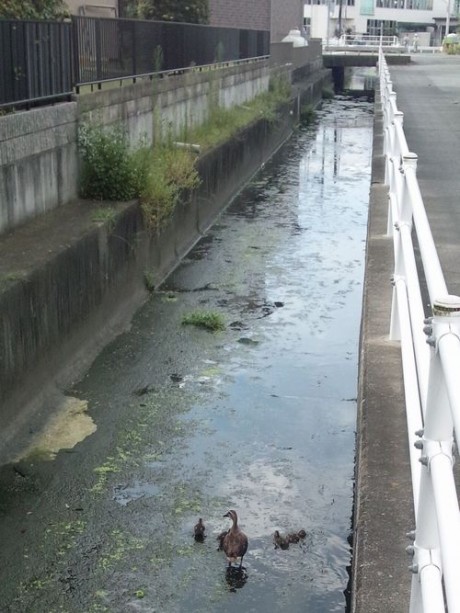
In the Shinobaragawa River of Hamamatsu City, a duck and her 5 children can be seen swimming along. August 30, 2012

Translated from the original article at: http://hamamatsu.keizai.biz/headline/701/

August 30, 2012
A family of ducks move along Shinobaragawa River.

During the early morning of August 30, a family of ducks were spotted in the Shinobaragawa River of Shinobara, in Hamamatsu City's West Ward.
Pictured: Surrounded by concrete, the duck family swims through the river.

A type of man made river, Shinobaragawa River runs through a residential town, connecting Lake Hamana  and Lake Sanaru. Typically, wild life such as fish are not often seen within such rivers. Near the area's elementary school, blocks have been placed near the water to enjoy a better look at the koi and carassius  that pass through, although ducks are not usually present.

Spotted in the river was a parent duck, thought to be the mother, swimming along 5 recently born ducklings.

The family came from the west, swimming up north along the Japan Nation Route 1. Day after day, in the intense heat, they were seen travelling through areas mostly devoid of water. Tilting their necks, area residents said to themselves, "I wonder where they came from..."


Original text:
浜松・篠原川でカモの親子-小ガモ5羽引き連れ歩く姿も
(2012年08月30日)

篠原川を進むカモの親子

浜松・篠原の篠原川(浜松市西区篠原)で8月30日の早朝、カモの親子が確認された。

【画像】コンクリートに囲まれた川を泳ぎ進むカモの親子

同川は浜名湖と佐鳴湖をつなぐ川から住宅街を通る準用河川。一般的に魚などはあまり見掛けられず、周囲の小学校には水辺で楽しめるようにブロックなどを配置してコイやフナなどが泳いでいるが、通常カモなどは見られない。

確認されたのは、母親と思われる親ガモが1羽と生後間もない小ガモ5羽を連れて泳ぐ姿。

カモは北側から泳いできて、国道1号線を潜って南へ泳ぎ進んだ。連日の猛暑で場所によっては水がほとんど無いところは親子で歩く姿も見られた。周囲に住む人は「どこから来たのだろう」と首をかしげていた。

Monday, August 13, 2012

A whale shark is spotted in the northern harbor of Sakata. A man from Sagae City captures a video.

Translated from the original article at: http://yamagata-np.jp/news/201208/10/kj_2012081000219.php

10:20PM, August 10, 2012
The whale shark, captured on video by a man from Sagae City

One report after another has been coming in of the whale shark in Sakata Bay. A self-employed business owner (male, age 46) of Sagae City took pictures and video after discovering the shark swimming near the docks of Sakata Bay. According to the Prefectural Experimental Fishery Station (Tsuruoka City): "So far, we haven't heard any reports of sightings within Shounai Bay."

The whale shark (Rhincodon typus) is part of the Rhincodontidae family of fish. It’s special trait is the pattern of dots on its body. In addition, it can reach a length of over 13 meters, making it the largest fish in the world. Feeding on plankton, it is not a "man eating shark". According to the fishery station, it resides within tropical and sub-tropical waters, although it doesn't specifically enter Japanese waters. [During the summer, it's will swim the Tsushima Strait, but we don't hear of it entering Japanese waters. This is quite rare," they explained.

On August 6th, after 5:00AM, the man witness the young whale shark (about 4-5 meters long) while fishing on the docks. Having a cell-phone camera, he took video as the shark spent 15 minutes swimming near the docks, comfortably swaying its tail from left to right before leaving. "No wonder I wasn't able to get much fishing done. But, that was an amazing experience." said the man.

Besides Sakata Harbor, on the evening of the 4th, the whale shark was seen swimming around a recreational fishing boat. During the day of August 5th, it was also said to be spotted 10 kilometers away from a pleasure boat . "We think both reports are about the same shark." said the fishery station. Hearing the eyewitness reports, spectators from Sakata City and Yuza-Machi gathered on the beach, yelling out together as their numbers increased. The fishery station added: Whale sharks are docile and pose no threat to humans, although one could be injured if hit by their tail fin. If someone spots a whale shark, we hope they observe it without fear."


Original text:
酒田北港沖でジンベエザメ 寒河江の男性が写真と動画撮影
 2012年08月10日 22:20

寒河江市内の男性が撮影したジンベエザメ

酒田沖でジンベエザメの目撃が相次いでいる。寒河江市内の自営業男性(46)は酒田北港の離岸堤近くを泳ぐジンベエザメを発見し、写真と動画を撮影した。県水産試験場(鶴岡市)は「庄内沖で見つかったという話は今まで聞いたことがない」としている。
 [ 動画はコチラ]

ジンベエザメはジンベエザメ科の魚で、体に斑点模様があるのが特徴。体長13メートル以上に及ぶものもおり、世界最大の魚類とされる。餌はプランクトンで、“人食いサメ”ではない。同試験場によると、太平洋などの熱帯、亜熱帯の海域に生息し、日本海にわざわざ回遊することはないものの、「夏なので対馬暖流に乗ってきた可能性がある。日本海にいないというわけではないが、とても珍しい」と説明する。

 寒河江市内の男性は6日午前5時すぎ、離岸堤で釣り中、体長4~5メートルの若いジンベエザメを目撃。携帯電話のカメラ機能で撮影した。男性の足元近くを15分間ほど右や左にゆったり泳ぎ、去っていったという。「道理で魚が全く釣れなかったわけだが、貴重な経験ができた」と男性。

酒田沖では他にも、4日夜に遊漁船が船の回りを泳ぐ様子を目撃、5日の日中にもプレジャーボートが約10キロ沖で姿を確認したという。同試験場は「同一の個体と思われる」。目撃情報を受け、酒田市や遊佐町は海水浴場の監視員らに監視強化を呼び掛けている。同試験場は「ジンベエザメはおとなしく人に危害を与えないが、尾ひれがぶつかるとけがをするので、もし見つけても驚かさずに見守ってほしい」としている。

Tuesday, June 19, 2012

A sea turtle lays eggs on the shores of Chigasaki/Kanagawa

Translated from the original article at: http://news.kanaloco.jp/localnews/article/1206190031/

June 19, 2012
A sea turtle arrived on land in order to lay eggs. (Photo provided by a reader)

On the morning of the 19th, a sea turtle was discovered laying eggs on the beach near Shirahamacho, Chigasaki City. According to the Shin Enoshima Aquatic Center, the type was a loggerhead sea turtle. The Civil Engineering Office of Fujisawa prefecture stated that in addition, last year sea turtles were confirmed to be laying eggs on the shores of Chigasaki.

At about 8:30 in the morning, receiving a report of a sea turtle by the 110 police sub-station, Chigasaki officials arrived at the location, By then, a crowd of onlookers were said to have already formed.

After laying the eggs, the sea turtle returned to the ocean at about 9:50AM. At the location, specialists obtaining data were said to have excavated and reburied the eggs.


Original text:
茅ケ崎の海岸で、ウミガメ産卵/神奈川
2012年6月19日

産卵のため海から上陸したウミガメ(読者提供)

19日朝、茅ケ崎市白浜町付近の海岸で、ウミガメ1匹が上陸して産卵しているのが発見された。新江ノ島水族館によると、「アカウミガメ」という。県藤沢土木事務所によると、昨年も茅ケ崎の海岸でウミガメが産卵する姿が確認されている。

午前8時半ごろ、「ウミガメがいる」と110番通報があり、茅ケ崎署員が現場に駆けつけると人だかりになっていたという。

ウミガメは卵を産み落とした後、午前9時50分ごろに海へ帰った。卵は、現場にいた専門家が埋め戻す対応を取ったという。

Thursday, June 7, 2012

The mystery of life and the peak spawning season for grass puffers/Yokosuka

Translated from the original article at: http://news.kanaloco.jp/localnews/article/1206070001/

June 7, 2012
Meeting the peak of spawning season, grass puffer fish release their eggs=Fukaura Bay, Urago-Cho, Yokosuka City

The peak spawning season has arrived for the grass puffer fish of Fukaura Bay, Urago-Cho, Yokosuka City. On the 6th, an observation group of 150 people made up of parents and children went to observe the mysteries of life.

With full tide approaching after 6PM, the group gathered along the shoreline in search of the spawning site. Swimming above the intense spraying waves, the males ejaculated on the eggs upon making contact with them. The spectator's cheers increased at the sight of the ocean’s cloudy surface.

Many grass puffer fish reside in the coasts south of Central Honshu, growing to a length of about 15 centimeters. Egg laying season lasts from the end of May until early July. For 2 to 3 days after both the full moon and new moon, the full tides of the evening are the peak time of observation.


Original text:
生命の神秘、クサフグ産卵最盛期/横須賀
2012年6月7日

最盛期を迎えたクサフグの産卵=横須賀市浦郷町の深浦湾

横須賀市浦郷町の深浦湾内でクサフグの産卵が最盛期を迎えている。6日に観察会が開かれ、親子連れなど約150人が生命の神秘を見学した。

午後6時を過ぎて満潮が近づくと、産卵場所を求めて波打ち際に群れとなって集まる様子が見られた。激しく水しぶきを上げながら雌の産卵に合わせて雄が射精し、海水が白濁すると見学者からは歓声が上がった。

クサフグは本州中部以南の沿岸に多く生息し、体長は15センチほど。産卵は5月下旬から7月上旬に行われる。満月と新月の2、3日後にかけて夕方の満潮時に観察できる。

Monday, January 2, 2012

The remains of a whale discovered on the beach of Odawara/Kanagawa January 2, 2012

Translated from the original article at: http://news.kanaloco.jp/localnews/article/1201020008/

The body of a whale discovered on the beach. The tongue is protruding from the mouth=Near the estuary of Morito river, Koyawata, Odawara city.

At the beach near the estuary of Morito river, Koyawata, Odawara city, a man passing by discovered the remains of a beached whale. Reporting it to city police, the discovery occurred around 6:50AM on January 2nd.

The investigation was assigned to the National Museum of Nature and Science (Taito Ward, Tokyo City). According to technical assistant Ishii Masayuki, the remains were that of a 6.3 meter long male humpback whale. Appearing to be an infant less than a year old, there were no conspicuous external injuries. The cause of death is not understood.

According to the city, the remains are arranged to be buried at shore.


Original text: 
小田原の海岸でクジラの死骸見つかる/神奈川
2012年1月2日

波打ち際で見つかったクジラの死骸。口からは舌が出ている=小田原市小八幡の森戸川河口付近

2日午前6時5分ごろ、小田原市小八幡の森戸川河口付近の海岸で、クジラの死骸が打ち上がっているのを、通り掛かった男性が見つけ、小田原署に届けた。

調査に当たった国立科学博物館(東京都台東区)の石井雅之技術補佐員によると、死骸はザトウクジラのオスで体長約6・3メートル。1歳未満の子どもとみられ、目立った外傷はなく、死因は分かっていない。

市によると、死骸は浜辺に埋葬される予定。